
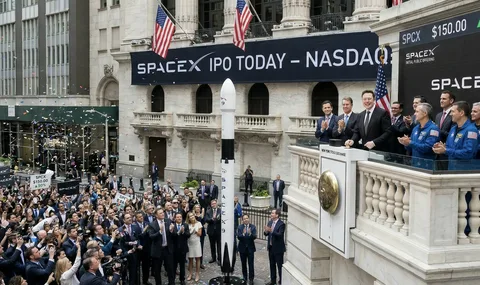
The global financial landscape has shifted permanently. On Friday, June 12, 2026, Elon Musk’s SpaceX completed its monumental initial public offering (IPO) on the Nasdaq exchange, shattering multiple historic records to become the largest stock market debut in human history.
Trading under the ticker symbol SPCX, the company priced its shares at a fixed $135 per share, raising an unprecedented $75 billion in gross proceeds. Investor enthusiasm completely defied traditional valuation screens; by the close of the first day of trading, shares jumped over 19% to finish at $160.95, pushing SpaceX’s total market capitalization to a staggering $2.1 trillion.
The explosive listing has fundamentally altered the global wealth hierarchy, officially minting Elon Musk as the world’s first-ever trillionaire thanks to his roughly 50% equity stake in the aerospace giant.
1. The Dynamic Revenue Structure: Inside the S-1 Prospectus
For nearly two and a half decades, SpaceX operated behind closed doors as a private sandbox. The mandatory public disclosure of its S-1 prospectus has finally revealed the internal mechanics of its three distinct corporate business divisions
Connectivity (Starlink): This segment functions as the undisputed financial engine of the company, generating roughly 69% of total corporate revenue. Starlink runs a highly profitable annual revenue run-rate of approximately $15.5 billion, pulling in $4.4 billion in operating profit.
Space Exploration: The legendary rocket division—encompassing Falcon 9, Falcon Heavy, and the developing Starship infrastructure—actually operates at a loss, pulling in $4.1 billion in 2025 but failing to offset its massive heavy capital expenditure.
Artificial Intelligence: In a massive corporate shift executed earlier this year, Musk officially folded his xAI venture and the social network X under the SpaceX umbrella. This division is currently absorbing billions in capital to construct orbital space data centers and methane-powered terrestrial superclusters.
Driven by the massive financial burn of its AI buildout and Mars colonization research, SpaceX posted a heavy net loss of $4.9 billion for the previous fiscal year, meaning public investors are betting entirely on future growth curves rather than current aggregate profitability.
2. Institutional Fast-Tracking and Index Distortions
Because SpaceX instantly debuted as the sixth-largest publicly traded company in the United States, passive index providers were forced to rapidly restructure their traditional regulatory gates to prevent tracking errors.
The divergence across the major Wall Street indexes has created highly unique conditions for passive retirement and index fund holders:
| Global Index Provider | New Acceleration Policy | Impact on Passive Investors |
| Nasdaq-100 | Bypassed old rules; fast-tracked entry to just 15 trading days post-listing. | Mandatory automated buying from massive funds like QQQ will trigger shortly. |
| MSCI Global Indexes | Approved early inclusion via emergency mega-cap amendments within 5 trading days. | International institutional trackers must purchase billions in underlying SPCX equity. |
| S&P Dow Jones (S&P 500) | Rejected fast-track entry, maintaining its rigid 12-month seasoning and financial viability screen. | SPCX inclusion is blocked from the S&P 500 until mid-2027 at the absolute earliest. |
3. Critical Risks Post-IPO: The Three Red Flags
While retail and institutional investors flooded the market—rendering the initial offer nearly four times oversubscribed with $250 billion in bids—independent equity analysts are urging extreme caution. Prospective shareholders must closely monitor three critical post-IPO structural developments:
Regulatory Backlash: The sheer consolidation of capital has triggered fierce political friction. Prominent U.S. Senators, including Elizabeth Warren and Bernie Sanders, have publicly condemned the IPO structure, calling for aggressive antitrust scrutiny regarding SpaceX’s deep integration with government defense tracking and global communications infrastructure.
Absolute Governance Control: According to the prospectus metadata, Elon Musk retains approximately 85% of total voting control through a specialized super-voting share class. Public shareholders possess zero ability to influence corporate decisions or executive compensation.
The December Lock-Up Expiry: Standard insider lock-up agreements are capped between 90 to 180 days. When early employees—more than 4,400 of whom became paper millionaires on Friday—alongside investment syndicates become legally free to sell their shares in December 2026, a massive wave of equity supply could trigger heavy downward pressure on the stock price.