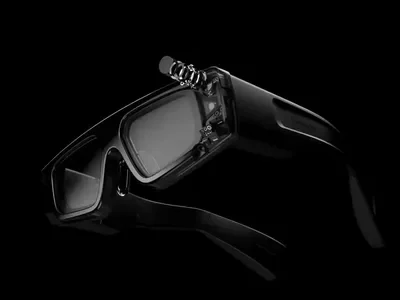


The traditional glass slab in your pocket is losing its crown. In a bold strategic declaration, Qualcomm has announced its intent to power the next wave of spatial devices meant to replace the smartphone.
Speaking in an interview with CNBC, Qualcomm CEO Cristiano Amon outlined a looming shift where conversational AI agents will replace traditional apps, handling multi-step tasks natively across device ecosystems.
To anchor this massive transition, the semiconductor titan utilized the Augmented World Expo (AWE 2026) in California to officially launch two major products aimed at moving computing away from phones and directly onto our faces and bodies.
1. Product One: The Snapdragon Reality Elite Platform
The undisputed flagship of Qualcomm’s announcement is the Snapdragon Reality Elite, a next-generation System-on-Chip (SoC) engineered specifically for premium extended reality (XR) headsets and optical see-through smart glasses.
Marking a major branding evolution from the older Snapdragon XR2 line, this processor is designed to handle immense on-device artificial intelligence and high-fidelity graphics within highly restricted, lightweight thermal frames.
The hardware layout marks a massive leap forward from past-generation silicon. The chip delivers up to 48 TOPS (Trillions of Operations per Second) of local AI performance, which Qualcomm demonstrated running a 3-billion-parameter large language model locally at a blistering 45 tokens per second.
Furthermore, a dedicated computer-vision block called the Engine for Visual Analytics directly offloads spatial tracking, depth estimation, and hand gestures. This allows the chip to run 12 degrees Celsius cooler and extend battery life by 20%, solving the core overheating issues that make face-worn computers uncomfortable.
The platform will make its commercial debut this Fall inside XREAL’s Project Aura glasses, a sleek optical wearable powered by the new Android XR operating system.
2. Product Two: The START Framework (Scalable Turnkey AI-Ready Toolkit)
To prevent developers from having to build alternative hardware ecosystems from scratch, Qualcomm simultaneously launched its second product: the Scalable Turnkey AI-Ready Toolkit (START).
START functions as a comprehensive, unified hardware and software blueprint designed to help hardware manufacturers rapidly prototype, construct, and scale non-traditional mobile devices.
Rather than focusing solely on head-mounted displays, the START platform standardizes sensor fusion, multimodal microphone arrays, and low-power camera streams. This toolkit is actively underpinning more than 40 distinct AI hardware designs currently in development across the tech industry.
By utilizing START, third-party brands can seamlessly build unobtrusive, always-on endpoints—such as smart jewelry, interactive pins, and camera-equipped earbuds—that can listen to a user’s voice, capture real-time visual context, and feed that data directly into an ambient AI assistant.
3. The Race to Replace the App Ecosystem
The simultaneous launch of the Reality Elite processor and the START architecture signals an aggressive commercial land grab. Qualcomm is betting heavily that the “center of gravity” of digital life is shifting away from smartphones toward ambient wearables.
| Metric Comparison | Modern Smartphone Architecture | Next-Gen Spatial AI Ecosystem |
| Primary Interface | Manual scrolling through siloed applications. | Conversational AI agents executing multi-step tasks. |
| Data Generation | Driven by active typing, media consumption, and taps. | Exponentially scales via continuous environmental video/audio feeds. |
| Market Scale | Mature, stagnant annual volume growth curves. | Projected to jump from tens of millions to hundreds of millions of units. |
By delivering the physical processing chips alongside the universal toolkit required to build alternative form factors, Qualcomm is positioning itself to be the foundational backbone of the post-smartphone world—ensuring that no matter what device eventually replaces the phone, it will still have Snapdragon silicon running the show inside.