

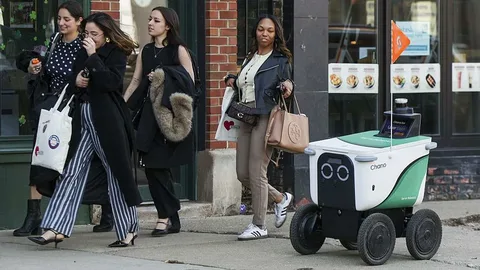
They were promised as the clean, cute, and hyper-efficient future of urban logistics—small, insulated coolers on wheels trundling quietly down the pavement to deliver smoothies and warm burritos. Instead, a wave of public resistance is swelling across major American cities.
From Los Angeles to Chicago, autonomous sidewalk delivery vehicles are transitioning from a quirky tech novelty into a major flashpoint of urban friction, corporate pushback, and community anger. Pedestrians, workers, and accessibility advocates are increasingly demanding that these machines clear the walkways.
1. Navigating the Human Cost: “Both Pity and Hate”
The most visible friction point is happening right where the rubber meets the concrete: our public sidewalks. Sidewalks were fundamentally designed for human travel, yet fleets managed by companies like Serve Robotics, Starship Technologies, and Coco are rapidly scaling up, with thousands of active bots navigating dense pedestrian zones.
The primary grievance is a paradox in the robot’s safety software. When a delivery bot encounters an oncoming human, its default protocol is to stop dead in its tracks to avoid a collision. However, on narrow or crowded walkways, this safety feature turns the machine into a stubborn, unyielding physical barricade.
Pedestrians are routinely forced to step into active bike lanes or off the curb onto busy streets just to bypass a stalled machine.
2. The Economic and Symbolic Divide
The backlash is not merely a reaction to crowded concrete; it is deeply rooted in growing economic anxieties regarding rapid automation.
Many community members view the machines not as a green alternative, but as a direct threat to low-wage gig economies. A delivery driver represents a neighbor making a living and circulating money back into the local community. A delivery robot, by contrast, is widely perceived as a tech conglomerate utilizing public infrastructure for free to systematically slice labor costs.
This underlying frustration has manifested in a dramatic spike in targeted vandalism and street hostility. Across social media networks, viral videos document a continuous cycle of abuse:
- Robots being aggressively kicked, tipped over, or spray-painted.
- Confrontational blockades where pedestrians deliberately stand in front of sensors to paralyze a bot’s route-planning engine.
- “Cargo theft” where lockboxes are breached mid-transit.
3. The Regulatory Nightmare: Cities Fight Back
Faced with a mounting volume of resident complaints, local governments are stepping in to halt the unregulated expansion of sidewalk drones. The industry is facing an uncoordinated, highly fractured legal landscape as municipalities prioritize pedestrian safety over tech-firm scalability.
| City / Jurisdiction | Active Regulatory Stance | Core Civic Concern |
| Chicago (1st Ward) | Halted all expansion plans for autonomous sidewalk couriers following intense neighborhood pushback. | Severe winter navigation issues and safety concerns for elderly pedestrians. |
| Glendale, California | Actively moving toward a formal moratorium on all delivery bots within city lines. | Sidewalk congestion and a complete lack of local business integration. |
| State of Kansas | Executive veto blocked statewide deployment rules, citing unresolved public liability gray areas. | Lack of clarity regarding insurance and accountability if a bot causes an accident. |
To combat this rising public relations disaster, robotics companies are attempting a psychological shift. Serve Robotics has started outfitting its machines with animated digital eyes, human-styled name tags, and pre-programmed audio prompts that politely ask humans to press crosswalk buttons for them.
While anthropomorphizing the boxes wins over some sympathetic bystanders, critics argue that wrapping corporate asset-expansion in a “cute” aesthetic does not solve the fundamental safety, accessibility, and legal hurdles of sharing human spaces with uncrewed commercial vehicles.
This video from KTLA 5 News provides a deeper look into how local Southern California communities like Glendale are legally moving to restrict food delivery robots due to ongoing pedestrian safety and sidewalk congestion issues.