
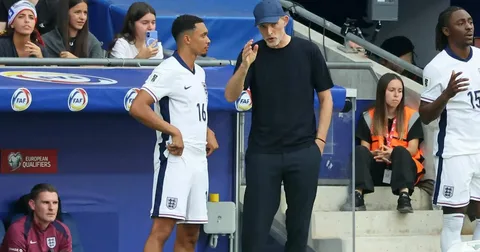
Under Thomas Tuchel, the England setup has become a laboratory of tactical rigidity, and nowhere is the tension between innovation and caution more visible than in the continued exile of Trent Alexander-Arno
For a player widely considered the most creative passer in English football, being relegated to a bystander in a World Cup year is a stark reality. To understand why, we have to look past the individual and into the “defensive gamble” that defines Tuchel’s reign.
The Tuchel Philosophy: Defensive Discipline Above All
Tuchel is not a manager who leaves room for defensive luxury. His philosophy is built on the premise that in tournament football, defensive errors are terminal. He has explicitly stated that he values defensive discipline and effort as non-negotiable traits.
When Tuchel arrived, he inherited a squad with a surplus of attacking talent but a reputation for defensive frailty in high-pressure moments. His “gamble” is the complete prioritization of a structured, disciplined unit. He is betting that if he can solidify the defensive third, the collective attacking quality—which England has in abundance—will be enough to win games. By demanding that every player, including full-backs, be 100% committed to the defensive phase, he is essentially filtering out anyone he deems a “defensive liability.”
What This Says About Alexander-Arnold
The exclusion of Alexander-Arnold is a direct indictment of how Tuchel perceives the Liverpool-trained defender’s profile. Despite his world-class ability to unlock defenses with a single pass, Tuchel seems to view Alexander-Arnold as a player who “relies heavily on his offensive contributions” while lacking the defensive focus required for the specific, rigid structure he demands.
For Tuchel, the risk of a “moment where you are not 100 per cent awake” outweighs the potential for a spectacular assist. It is a harsh, binary view:
- The Conflict: Alexander-Arnold’s brilliance lies in his freedom to roam, drift into midfield, and deliver crosses that few in the world can replicate.
- The Constraint: Tuchel’s system requires full-backs to hold their positions, track runners, and prioritize the prevention of counter-attacks above all else.
By limiting Alexander-Arnold to a mere 26-minute cameo against Andorra, Tuchel has effectively signaled that he is willing to leave arguably his most technically gifted creative asset on the bench if it means maintaining the tactical integrity of his backline.
The Higher Stakes
This is a high-stakes gamble. If England wins the tournament or makes a deep run, Tuchel’s decision will be vindicated as the masterstroke of a pragmatist who knew how to balance the team. However, if England struggles to create chances against stubborn, low-block defenses, the absence of Alexander-Arnold’s “X-factor” will become the primary narrative of failure.
Ultimately, this saga highlights a clash between individual genius and systemic order. Tuchel is choosing the safety of the collective over the volatility of the star. Whether that choice proves to be a visionary tactical decision or a stubborn error remains the most compelling subplot of England’s 2026 campaign.
Understanding the Tactical Divide
This video explores the nuances of Tuchel’s defensive setup and the tactical hurdles players like Alexander-Arnold face when trying to adapt to such a demanding, structured system.
Tuchel’s Tactical Setup Explained
This video provides direct insight into how Thomas Tuchel views his squad selection process and the rigid standards he expects from his players ahead of the World Cup.